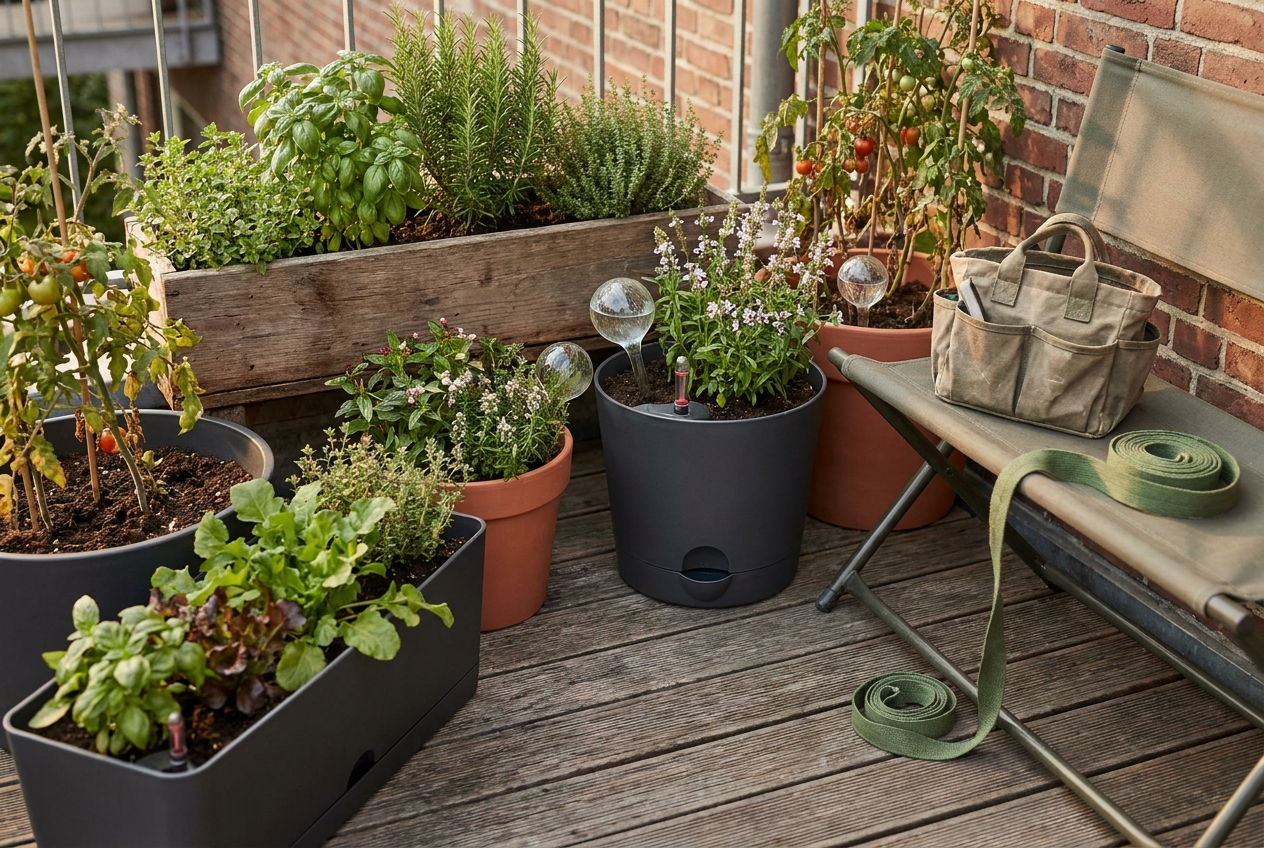
Gardening in open ground forgives a great many mistakes: the soil is large, it buffers swings, it holds water, and it hosts roots that can go looking for whatever is missing. None of that happens in a pot. A container is a closed ecosystem of a few litres, with a water reserve that runs out in hours in summer, a minimal thermal mass that heats and freezes fast, and roots with nowhere else to go. That is why a pot is not a decorative accessory: it is the soil. Choose it badly and you condemn a healthy plant before you even plant it. This guide lines up the five parameters that actually matter — volume, drainage, material, water reserve and weight — and uses them to get through the most delicate stretch of the year, the one running from the end of summer to the first frost.
1. The pot is the soil, not the container
The first thing to understand is that a potted plant lives in a finite, knowable volume. Every litre of substrate holds a certain amount of available water, hosts a certain amount of root and contains a certain amount of nutrients. When any one of those three limits is reached, the plant stops growing — not because of disease, but because of arithmetic. It is why a basil bought in a fourteen-centimetre pot stops producing leaves after three weeks on the windowsill: it is not short of sunlight, it is short of the litre of water that pot cannot hold.
The second element is rhythm. In the ground, water descends, rises again by capillarity and redistributes slowly. In a pot the cycle is brutal: everything gets wet, it drains in ten minutes, it dries from the top down, and on a thirty-two degree day with wind a five-litre container facing south can go from saturated to dry in under ten hours. Which means choosing a volume is not a question of aesthetics or available space, but of the watering frequency you are realistically willing to sustain.
Third element: temperature. The walls of a pot are in direct contact with the air and the sun. A dark container exposed to the afternoon can exceed forty degrees on its south-facing wall, and the roots pressed against it are effectively cooked. This is not a marginal detail: in most cases where a balcony plant declines in August for no visible reason, the problem is not the canopy but the root ball on the hot side.
2. Materials, and what they actually change
Every material is a compromise between three variables: how much water it holds, how much it weighs, how long it lasts outdoors. There is no best material in the abstract; there is the one that matches your exposure and the frequency with which you can realistically water.
Plastic and polypropylene
This is the most rational material for a balcony. It does not breathe, so water evaporates only from the surface of the substrate and not through the walls: at equal volume, a polypropylene pot needs fewer waterings than a terracotta one, often forty per cent fewer on windy days. It is light, which on a balcony with limited load capacity is a real advantage. It is also the material almost every self-watering system is built on, because an impermeable wall is the precondition for holding a reserve. The drawback is thermal behaviour: dark versions get very hot, and low-grade plastics turn brittle after two or three seasons of ultraviolet. A UV-stabilised polypropylene of decent thickness, by contrast, lasts many years without bleaching or cracking.
Fibre, composite and metal
Fibre pots, often combined with a metal structure, occupy the middle ground: they have the matte, tactile look of stone, a weight close to plastic and good dimensional stability. They are the typical choice when a pot has to sit in a furnished setting — an entrance, a terrace lived in as an outdoor room — and must not look like equipment. Watch two things: how the finish holds up to frost, which on cheap products flakes after the first winter, and whether the base is actually drilled, because several decorative versions are conceived as cachepots rather than pots.
Terracotta
Terracotta is porous, and that is both its quality and its limit. It breathes, so it oxygenates the root ball and forgives a great deal to compulsive waterers: it is the right container for Mediterranean herbs, succulents, anything that suffers from standing water. For the same reason it dries very fast in full sun and by late July may need watering twice a day. It is also the material most exposed to frost, because water absorbed by the wall expands and flakes the clay from within. Terracotta declared frost-resistant costs more and is worth every franc in a region that drops below zero.
Concrete, granite and reconstituted stone
These are permanent-position containers. High thermal mass, so roots suffer less from day-night swings; total stability in wind, which with tall shrubs is a genuine requirement and not a luxury; effectively unlimited lifespan. The price is weight: an eighty-centimetre rectangular granite planter filled with wet substrate weighs as much as an adult, and should be positioned once, knowing where. On a balcony that opens the chapter almost nobody addresses, namely load capacity.
3. Drainage, or the most frequent cause of death
Waterlogging kills far more balcony plants than drought, and it does so insidiously, because the symptoms — yellow leaves, stalled growth, a generally unhappy look — are identical to those of thirst. The mechanism is simple: roots breathe, and in a saturated substrate the oxygen runs out. After a few days the fine roots rot, the plant stops absorbing water and looks thirsty. Anyone who does not know the mechanism waters again, and closes the loop.
Holes, feet and the contact surface
The first requirement is obvious and should be checked before buying: the base needs adequate holes, not a single symbolic one. The second is less obvious: the pot must not sit flush on the floor, or the surface tension of the water blocks the drip. Integrated feet, a two-centimetre riser, even two strips of wood solve the problem permanently. On tiled terraces this single precaution changes the fate of half the pots.
The saucer that floods
A saucer exists to protect the floor, not to stockpile water. If there is still water in it half an hour after watering, empty it: that water is not being absorbed, it sits against the drainage holes and keeps the bottom few centimetres of substrate saturated — which is exactly where the most active roots are. Pots designed with a separate reserve are a different case, where the water level is isolated from the substrate and a dedicated mechanism is needed to draw it up. More on that immediately.
4. Water reserves and self-watering: how they really work
The word self-watering creates the wrong expectation. No pot produces water: what a reserve system does is decouple the moment you pour water from the moment the plant uses it. It is a change of rhythm, not a change of quantity.
The principle of capillary rise
The classic self-watering pot has a double base. Below sits an isolated water chamber; above sits the substrate, connected to the chamber by a wick, a felt cone or a column of soil descending into the reserve. Water rises by capillarity only if the substrate at that point is drier than the reserve: in effect the plant calls for water when it needs it. A level indicator lets you know when to refill without digging. The practical advantage is enormous in two situations: absences of four or five days, and plants that suffer from pronounced wet-dry cycles, such as many foliage ornamentals.
Two conditions make it work. The first is that the substrate must be sufficiently structured: soil that is too fine compacts and blocks capillarity, soil that is too coarse interrupts it. The second is running-in: in the first weeks after transplanting, roots have not yet reached the rise zone, so you water normally from above and leave the reserve empty. Filling the chamber on day one is the mistake that turns a good pot into an aquarium.
Watering globes: what they can and cannot do
Automatic watering spheres work on a different principle, that of depression: water leaves the neck buried in the soil only when the surrounding substrate dries out and lets air in. They are honestly useful for a short absence, for small and medium indoor pots, and as a supplement. They do not replace watering an outdoor pot in high summer, because their output is on the order of a few dozen millilitres a day and a ten-litre container in the sun consumes ten times that. It is worth inserting them into already-moist soil: in a dry substrate they empty within an hour.
When a reserve is contraindicated
Not every plant appreciates one. Mediterranean herbs, succulents, rock-garden plants and generally anything that grows naturally on poor, free-draining soil suffers in an environment that is permanently damp at the base. For these, terracotta and generous drainage remain the correct choice. And in winter the reserve must be emptied in any case: standing water in a closed chamber that freezes means a cracked wall.
5. Sizing: volume, format and weight
How big, in practice
The most reliable working rule is to think in litres, not centimetres. Annual herbs and salads do well in three to five litres per plant; balcony tomatoes want at least twenty litres each, and below that threshold they produce little whatever the label claims; a small perennial shrub starts at thirty to forty litres; a citrus wants fifty and up. Move up in stages: increasing the volume too much at once leaves large zones of substrate without roots, which stay wet for a long time and encourage rot.
Rectangular balcony troughs
The long rectangular format is the most efficient per linear metre of railing, but it hides a trap: many models are wide and long yet shallow. A one-metre container with only fifteen centimetres of usable depth offers fewer litres than its footprint suggests, and dries extremely fast. For herbs and annual flowers that is perfectly fine; for anything with a serious root system, look at the height before the length. Below twenty centimetres of depth you are in seasonal-planting territory.
Weight, the constraint nobody calculates
Wet substrate weighs roughly between 0.8 and 1.2 kilograms per litre depending on composition. That means a fifty-litre trough at full load sits around fifty to sixty kilos, plus the pot itself: a rectangular stone-material planter can comfortably reach a hundred. On balconies, load capacity is defined by the structural design and the load should be distributed, not concentrated at a single point near the railing. This is exactly why large fibre and polypropylene containers exist: they offer the same usable volume at a fraction of the mass.
6. Seven mistakes that cost a season
Buying a cachepot while believing you are buying a pot. Many decorative containers have no holes. If you love the piece, use it as an outer shell and keep the plant in its technical pot inside, raised off the base.
Filling the base with expanded clay for no reason. A drainage layer in an already-drilled pot reduces usable volume and raises the saturated zone instead of lowering it. It only helps in containers with no outlet, where it is a palliative rather than a solution.
Reusing exhausted substrate. After a season, the soil in a pot is compacted, depleted and often water-repellent. It needs regenerating with amendment and structuring material, not simply topping up.
Watering little and often. A glass of water a day wets the top two centimetres and pushes roots upward, where temperature swings hardest. Better to water deeply, until water runs from the holes, then let it dry.
Watering by the clock instead of by feel. A finger five centimetres into the soil remains the best sensor available. Light rain, which often wets only the leaves, makes the trap even more insidious.
Ignoring wind exposure. On a balcony, wind dries more than sun. A tall narrow pot in an exposed position needs waterings the same pot in a sheltered nook would never ask for.
Leaving plants tied as they were last year. Support belts and ties need checking every season: a stem thickening inside a tight tie strangles itself and snaps in the first storm.
7. The work: posture, tools and surfaces
Container gardening consists of short, repeated operations, nearly all of them at ground level: repotting, cleaning, moving substrate, checking. The physical consequence is familiar to anyone who has spent an autumn afternoon crouched on a terrace. Two things change the experience radically. The first is having a low, stable seat instead of kneeling: a folding garden bench, ideally reversible into a kneeler, cuts the time spent bent over and lets you work longer without paying for it in the evening. The second is working flat and at the right height: a growing or potting table raises the work surface to about seventy centimetres and turns repotting from a balancing act into an orderly operation, with substrate contained rather than scattered.
On tools, one rule applies: few, good, and always in the same place. A rigid transplanter, clean secateurs, a pair of gloves, a support belt for ties and stakes, a container for substrate. The tool bags built into folding benches are not a marketing accessory: they are the difference between starting work in thirty seconds and postponing the repotting by another week — which is the real reason plants stay root-bound far too long.
8. Late summer, autumn, frost: the container calendar
Late August and September: the good window
The end of summer is the best moment of the year to repot perennials and put things in order. The soil is still warm, roots are active, but the canopy's water demand is falling: which means the plant has weeks ahead to rebuild roots before winter dormancy, without simultaneously supporting foliage in full growth. It is also the right period to replace spent seasonals, divide clumps that have outgrown their space and rescue the troughs that spent the summer facing south.
October and November: preparing for cold
Three operations do almost all the work. First: empty the water reserves of every self-watering pot and disconnect automatic irrigation, because standing water that freezes cracks chambers, tubes and fittings. Second: raise off the ground any pots staying outside, with feet or wooden strips, so rainwater drains and the base does not freeze into a slab. Third: group the more delicate containers along a sheltered wall — mass that warms by day returns heat at night, and the group protects the pots in the middle. Potted plants suffer frost far more than the same species in open ground, because the root ball freezes from every side.
Frost and materials
Not every container survives a winter outdoors. Terracotta not declared frost-resistant flakes; concrete and reconstituted stone hold up well provided they do not stay full of water; good-quality polypropylene is the most relaxed material, as long as it is not knocked when very cold, because low temperatures make it more brittle. Fibre pots with decorative finishes need checking case by case. The practical rule: if a container is declared for indoor or seasonal use, it spends the winter under cover, not on the balcony.
9. Maintenance and lifespan
A well-kept pot lasts decades, and that is the real economic argument for container gardening. Maintenance is minimal and concentrated at the end of the season. Empty it, brush the inner walls to remove salt deposits — those whitish streaks are limescale and fertiliser residue, and over time they worsen drainage — and let it dry completely before storing. The holes need clearing: they clog with dry roots and compacted substrate, and a pot that does not drain is a pot that will kill whatever gets planted in it next season.
For double-based containers, cleaning the chamber matters as much as cleaning the pot: water standing for months leaves biofilm and deposits that reduce wick capillarity. A rinse and a wipe are enough. Metal parts — frames, hooks, supports — should be checked for corrosion at contact points, which is where moisture lingers longest. Finally, the honest assessment: a plastic pot that has lost elasticity and shows radiating micro-cracks should be replaced before filling it, not after moving it full.
Mini-FAQ
How often should a balcony pot be watered in summer?
There is no fixed frequency: it depends on volume, material, exposure and wind. The useful rule is to check the substrate five centimetres down and water deeply only when it is dry, until water runs from the holes. In high summer a small south-facing container may need two waterings a day, while the same volume in a sheltered spot may manage on one every two days.
Do self-watering pots work outdoors too?
Yes, and they are particularly useful on very sunny balconies, where they reduce how often you have to intervene. Two precautions apply: an empty reserve in the first weeks after transplanting, and an empty reserve before winter. They are not suited to plants that need the substrate to dry out between waterings.
Is a drainage layer at the bottom really necessary?
In pots with adequate holes, no: it reduces usable volume without improving drainage. It only makes sense in containers with no outlet, where it creates a collection zone separated from the roots — and even then it is a fallback compared with a drilled pot.
Can I leave large pots on the balcony all winter?
It depends on material and region. Containers declared frost-resistant, raised off the ground, with reserves emptied and grouped along a sheltered wall come through winter without trouble in most situations. Non-frost-resistant terracotta, decorative indoor containers and pots full of standing water are the reliable candidates for cracking.
The selection
A cross-section from the Gardening category: containers with reserves, balcony formats, work surfaces and small watering systems. Tested, documented, useful.
- Stefanplast Cloe Self-Watering Pot 25 x 25 x 25 cm (6 units) — the twenty-five-centimetre cube is the best-balanced compromise for balcony herbs and ornamentals, and the multipack lets you standardise a whole row.
- Lechuza 13158 Planter 40 x 40 x 75 cm — a tall container with an integrated reserve system, designed for shrubs and foliage plants in a fixed position: serious volume, manageable weight.
- EDA Anthracite Planter 99 x 39 x 43 cm — nearly a metre of frontage with forty-three centimetres of height, which means real depth: the format that lets you grow something more demanding than seasonals.
- EDA Rectangular Balcony Trough in polypropylene — the classic railing format, in a material that holds moisture better than terracotta at a fraction of the weight.
- Riviera Rectangular Granite Planter 80 x 40 cm — thermal mass and wind stability for permanent ground positions, where weight is an advantage rather than a problem.
- Home ESPRIT Metal and Fibre Planter Set 41 x 41 x 32 cm — a tactile, furniture-grade look at contained weight, for terraces lived in as outdoor rooms.
- Situl 3-in-1 Folding Garden Bench with Tool Bag, InnovaGoods — seat, kneeler and tool bag: the object that genuinely reduces postponed repottings.
- EDA Growing Table 73 x 38.5 x 68 cm — a raised potting surface: working at seventy centimetres instead of at ground level changes the physical sustainability of a season.
- Aqua·Loon Automatic Watering Globes, InnovaGoods (2 units) — a useful supplement for short absences and medium pots, to be inserted into already-moist substrate.
- Ribimex Support Belt 25 mm x 3 m — a wide, soft tie for stakes and stems: the width is what stops the plant being strangled as it thickens.