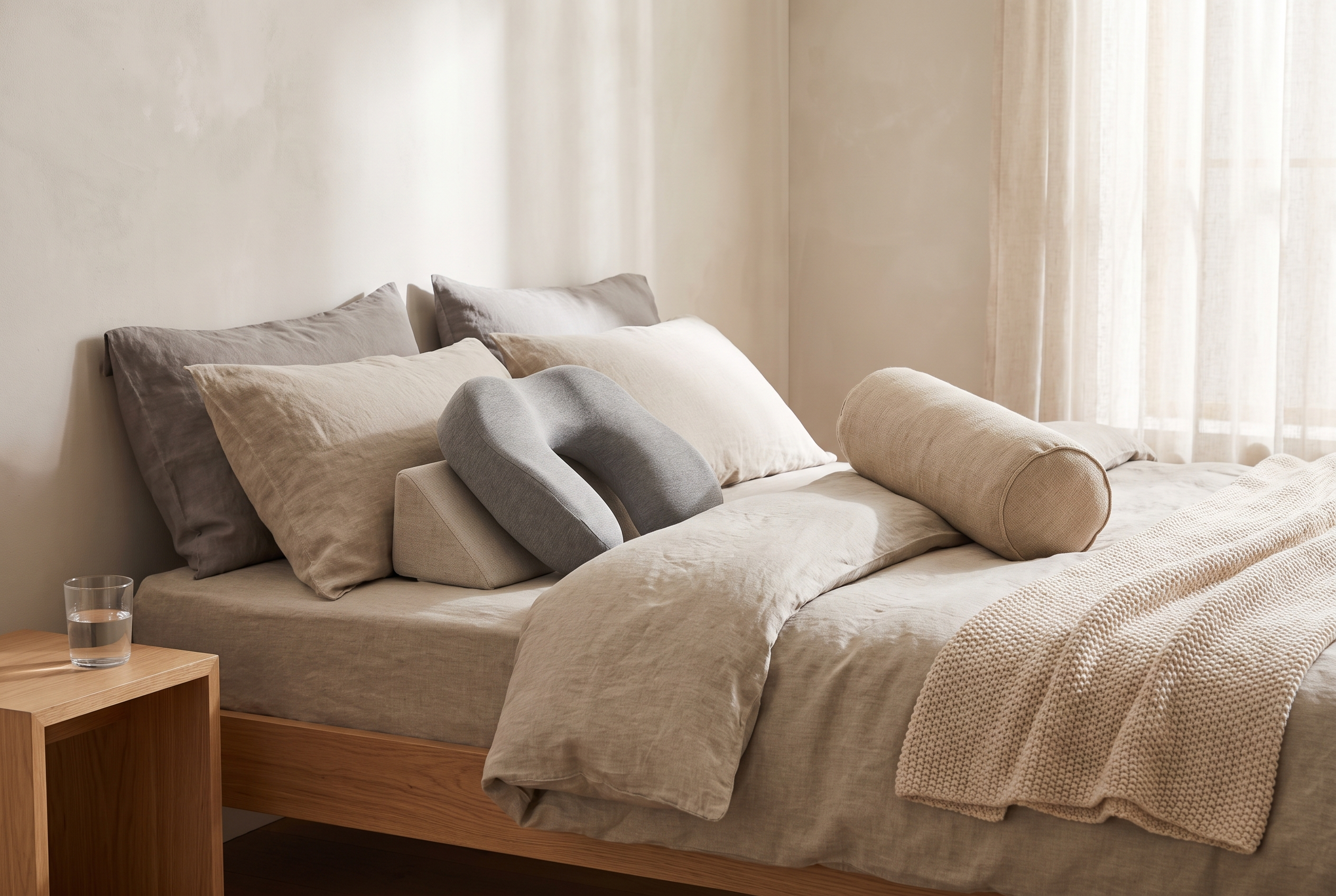
When rest is not working, the first suspect is almost always the mattress. It is the most expensive explanation and, in most cases, the least likely one. A mattress decides which surface the body lies on; pillows decide what shape the body takes on that surface. The difference between the two is the difference between the floor of a room and the furniture standing on it: the floor matters, but the furniture determines whether you are comfortable. Positioning pillows — contoured cervical pillows, lumbar wedges, knee pillows, modular bolsters, reading backrests — are the furniture of rest. They cost a fraction of a mattress, can be tested in a single night, move from room to room and correct exactly the point where the body gives way. This guide lines up the parameters that actually matter — height, density, material, sleeping position, contact surface — and closes with a real selection from the catalogue. One clarification before we start: this is about comfort and domestic ergonomics, not therapy. A pillow cures nothing, and the right answer to persistent pain is a professional, not a purchase.
1. Why rest always breaks at the same point
A lying body is not a straight line: it has protrusions and hollows that change depending on how it rests. On your back, the curve of the neck leaves a gap between the nape and the surface; on your side, the gap moves between the head and the shoulder and is far deeper, because the entire width of the shoulder has to be filled. In both cases, if that gap is not filled by something, it is filled by the body itself: muscles contract to hold the position, and a muscle that works all night is a muscle you notice in the morning. This is why someone can change three mattresses and still wake up with a stiff neck. The problem was never the surface underneath, it was the gap above.
The second point where rest breaks is the pelvis. When you sleep on your side with your legs stacked, the upper leg slides forward and drags the pelvis into rotation; the lumbar spine follows. It is not dramatic for one night, but it becomes so if it is the habitual position for seven hours a night over years. Here too the correction is trivial and cheap: a volume between the knees that keeps the legs parallel and the pelvis neutral. It is the same principle by which the gap under the lumbar curve, when you sit for long stretches, should be filled by a spacer rather than by the muscles of your back.
The filling rule, not the support rule
Commercial vocabulary talks about "support", and this creates a misunderstanding: it suggests that firmer and taller is better. The correct criterion is different and easier to verify at home. A positioning pillow does not have to support the body, it has to fill the empty space between the body and the surface, without pushing it and without letting it drop. A pillow that is too tall pushes the head forward and closes the neck; one that is too low lets it slide backwards. Both fail in the same way, by changing alignment; the fact that one is "soft" and the other "firm" is secondary.
2. The five families of positioning pillows
The contoured cervical pillow
It has a wave profile with two lobes of different height and a central hollow for the nape. The taller lobe goes towards the shoulder and serves side sleepers, the lower one back sleepers: in practice you choose the side by turning the pillow, not by buying two. It is the most technical family and also the one with the longest adaptation period, because it imposes a position rather than adapting to the one you already have. People coming from a soft traditional pillow often find it unpleasant for three or four nights and then never go back; people who judge it after the first night almost always discard it unfairly. The Conforti contoured memory foam cervical pillow belongs exactly to this category.
The side-sleeping pillow
A U or crescent shape, designed to be hugged: one part goes under the head, the rest passes in front of the chest and ends between the knees. It solves both gaps of a side sleeper in a single object, the one above the shoulder and the one between the legs, and is the most efficient choice for someone who already knows they are a stable side sleeper. It takes up space: in a shared double bed it has to be agreed on, because it is bulky by definition. The Slupill U-shaped ergonomic side-sleeping pillow is the typical representative of the family.
The knee pillow
The smallest, the cheapest and the one with the highest ratio between cost and perceived difference in the whole category. A shaped volume that sits between the knees and keeps the legs parallel. The detail that separates a useful model from one that ends up on the floor within half an hour is the strap: without it, the pillow shifts at the first change of position; with it, it stays where it is needed. The Lerellow knee pillow with support strap is built precisely around that detail.
The lumbar cushion
A shaped spacer that fills the curve of the back. It was born for seating — armchair, desk chair, car seat — but it is also useful in bed for people who read sitting against the headboard. The decisive variable is depth: too thin fills nothing, too thick pushes you forward and makes the pelvis slide. Gel versions, such as the Glushion gel lumbar cushion with removable cover, add a practical advantage you do not notice in September and do notice in May: they dissipate heat better than solid foam, and they are the most sensible choice for anyone who sits for many hours.
The reading backrest and the modular bolster
The backrest with armrests is a piece of furniture disguised as a pillow: it replaces the headboard, lets you sit up in bed without your shoulders sliding down, and holds your arms while you hold a book or a tablet. It is the solution for people who use the bed while awake as well. Models with padded armrests vary mainly in backrest height and in the stiffness of the internal structure. The modular bolster, by contrast, is the philosophical opposite of the contoured cervical pillow: instead of imposing a shape, it is assembled. A modular roll cushion becomes neck support, lumbar rest or leg elevation depending on how you arrange it, which makes it the most rational choice when you have not yet worked out where the problem lies.
3. Materials, and what they actually change
Memory foam
It reacts to heat and pressure: it softens where the body rests and holds its shape elsewhere. It distributes load well and is the most suitable material for contoured profiles, because it keeps the geometry it was given. Its two limits are well known and neither is a manufacturing defect. The first is thermal: it retains heat, and you feel it in summer. The second is responsiveness: it reacts slowly, so anyone who turns often during the night perceives a moment of delay before the pillow adapts to the new position. Perforated versions or ones with gel inserts soften the first problem, not the second.
Gel and ventilated foams
Gel works as thermal mass: it absorbs heat instead of reflecting it and gives a cool sensation in the first hours. It does not cool, it dissipates, and the difference shows up mostly in prolonged sitting rather than in sleep. It is the material with the best compromise for thin spacers — lumbar cushions, precisely — where solid foam would end up either too yielding or too rigid.
Fibre and microfibre
Immediate softness, contained price, no adaptation period. In exchange, it compresses: after a few months the effective height drops and the gap comes back. It is perfectly fine for uses where shape matters less than softness — a sofa cushion, an occasional leg rest — much less so where geometry is the function.
Microbeads and granular fills
They mould instantly and remember nothing, which is both the strength and the limit. Excellent for mobile and temporary uses, weak as stable support for a whole night.
4. Choosing from the position you sleep in
On your side
The most common position, and the one that demands the most height, because the gap to fill is as wide as the shoulder. You need a tall, stable pillow under the head, and almost always a second volume between the knees. The check is done while still, with the help of another person or a mirror: lying on your side, nose, sternum and navel should be on the same line, and the head should tilt neither towards the shoulder nor upwards. If the head drops down, the pillow is too low; if the neck bends upwards, it is too tall.
On your back
The gap to fill is much smaller: a low profile that supports the cervical curve without pushing the chin towards the chest is enough. This is the most common mistake of people who buy a tall pillow assuming tall means comfortable. For back sleepers, a second pillow under the knees reduces tension in the lumbar area more than any change to the head pillow.
Face down
The hardest position to correct, because it forces the neck to rotate. People who habitually sleep this way do better with a very low pillow or nothing at all under the head, and with a thin volume under the pelvis to reduce the arching of the back. No technical pillow improves this position: you accommodate it, you do not optimise it.
Two people, different needs
The most frequent case and the least considered by catalogues. Two people who sleep in different positions need two different heights, and the solution is not a compromise halfway between them — which is wrong for both — but two distinct pillows. Where the bed is narrow or waking hours are shared too, there are formats designed for couples, such as the Cozzy memory foam cervical pillow for couples, which solve the arm-space problem without asking either person to settle for the wrong height.
5. The rest that is not sleep
A substantial share of the hours in which the body is still is not sleep: it is reading, television, laptop work propped against the headboard, an afternoon on the sofa. These are hours in which posture is worse than in sleep, because the body is held in balance by active muscles rather than resting. This is where positioning pillows make the most visible and most immediate difference, with no adaptation period.
Three corrections almost always apply. First: anyone who reads in bed needs a backrest, not a stack of pillows, because the stack slides and forces you to rearrange yourself every ten minutes. Second: anyone working at a laptop while seated needs a lumbar spacer, otherwise the pelvis rotates and the back rounds within the first quarter of an hour. Third: anyone watching a film on the sofa is better off with a rise under the knees than with an extra cushion behind the head. A multifunction ergonomic cushion covers more than one of these uses and is often the first sensible purchase for someone who does not yet know what their main problem is.
6. Five mistakes that keep repeating
Judging after the first night. A contoured pillow changes your habitual position, and every change of position produces a sensation of discomfort that is not a verdict on product quality. The correct evaluation window is five to seven nights. Below that threshold you are measuring habit, not the pillow.
Stacking pillows to gain height. Two pillows on top of each other do not make a tall pillow: they make an unstable stack that separates during the night and which, being yielding in the centre, ends up supporting less than a single pillow of the right height.
Buying based on softness felt in the shop. The hand is not the neck. A few seconds of pressure with your palm says nothing about how that material will behave under seven kilos of head for seven hours.
Ignoring shoulder width. It is the parameter that decides the correct height for a side sleeper, and no catalogue asks for it. A broad-shouldered person buying a "medium" pillow is buying a low pillow.
Keeping the same pillow for years. Foams lose elasticity, fibres compress. A pillow that does not spring back when you fold it in half and release it has finished its work, whatever it looks like from the outside.
7. Maintenance: what decides how long it lasts
The most important rule concerns water. Memory foams and gels must not be soaked or put in the washing machine: they absorb, deform and never dry completely inside. This is why a removable, washable cover is not an aesthetic detail but the real hygiene criterion of the whole category: it is the only part that can genuinely be washed, and it is the part in contact with the skin. A technical pillow without a removable cover is a pillow that cannot be cleaned after a year.
The body of the pillow is maintained by airing it. Half an hour in the open air, away from direct sun, once a week is enough to let accumulated moisture evaporate; direct sun should be avoided because it yellows and stiffens foams. The chemical smell of the first days — typical of memory foam just out of vacuum packaging — dissipates on its own in a ventilated room within two or three days, and requires no treatment.
On replacement, the test is mechanical and takes five seconds: fold the pillow in half and let go. If it returns to its original shape, it is still working. If it stays folded, or takes many seconds, it has lost its structure. On positioning pillows — which work through geometry rather than volume — that loss translates directly into the return of the problem they had solved.
8. Why September is the right month
There is a practical reason and a physiological one. The practical reason is that habits re-form in September: fixed schedules return, you go back to sleeping in your own bed after weeks in other people's, and any change introduced now has months of stable routine ahead in which to be assessed. Changing pillow in mid-August means testing it in abnormal conditions; doing it in September means testing it in real ones.
The physiological reason concerns temperature. Memory foam materials are sensitive to ambient heat: the same pillow feels softer at twenty-eight degrees and firmer at eighteen. A cervical pillow bought in high summer and judged "right" can turn out firmer than expected when the room drops ten degrees. Autumn, with intermediate night temperatures, is the window in which perception is closest to the yearly average — and therefore the moment when a verdict on a pillow is most likely to still hold in January.
9. Quick questions
How many pillows do you actually need? For a side sleeper, two: one under the head and one between the knees. For a back sleeper, two: a low one under the head and one under the knees. People with four on the bed generally use one and move the other three.
Is a cervical pillow right for everyone? No, and not because it is difficult: because it imposes a height. It works well for people who sleep mostly in one stable position, less well for people who change position constantly.
Is memory foam better than gel? They are different tools. Memory foam is better where a shape has to be held; gel where thin spacers and heat dissipation are needed. In prolonged sitting gel has a concrete advantage, in side sleeping memory foam does.
How often should it be replaced? There is no calendar deadline: there is the fold test. Under normal daily use, a well-maintained technical pillow works well for several years; a fibre one for far less.
Do you need a different pillow for the sofa? Not necessarily different, but dedicated yes. A pillow that migrates from bed to sofa and back gets twice as dirty and is never where it is needed.
The selection
What follows is the quickest way to navigate the Rest category: one representative model for each of the needs described above.
- Conforti contoured memory foam cervical pillow, InnovaGoods — the reference contoured model, for a stable sleeping position.
- Slupill U-shaped ergonomic side-sleeping pillow, InnovaGoods — solves head and knees in a single object for side sleepers.
- Lerellow knee pillow with support strap, InnovaGoods — small, inexpensive, with the strap that stops it sliding away.
- Glushion gel lumbar cushion with removable cover, InnovaGoods — for long sitting, washable cover and heat dissipation.
- Huggilow reading cushion with armrests, InnovaGoods — a structured backrest for people who use the bed awake too.
- Huglow reading cushion with armrests, InnovaGoods — same function in a more contained format, for narrow beds.
- Ullow multifunction ergonomic cushion, InnovaGoods — the first sensible purchase when you do not yet know where the problem is.
- Rollow modular multifunction cushion, InnovaGoods — assembled to order: cervical, lumbar or leg elevation as needed.
- Cozzy memory foam cervical pillow for couples, InnovaGoods — designed for a shared bed and for arm space.
Tested, documented, useful: the Dedalshop Rest selection does not chase novelty, it lines up objects that fill one specific gap. If it is not clear which gap is yours, start with the cheapest on the list and watch what changes over the following week.