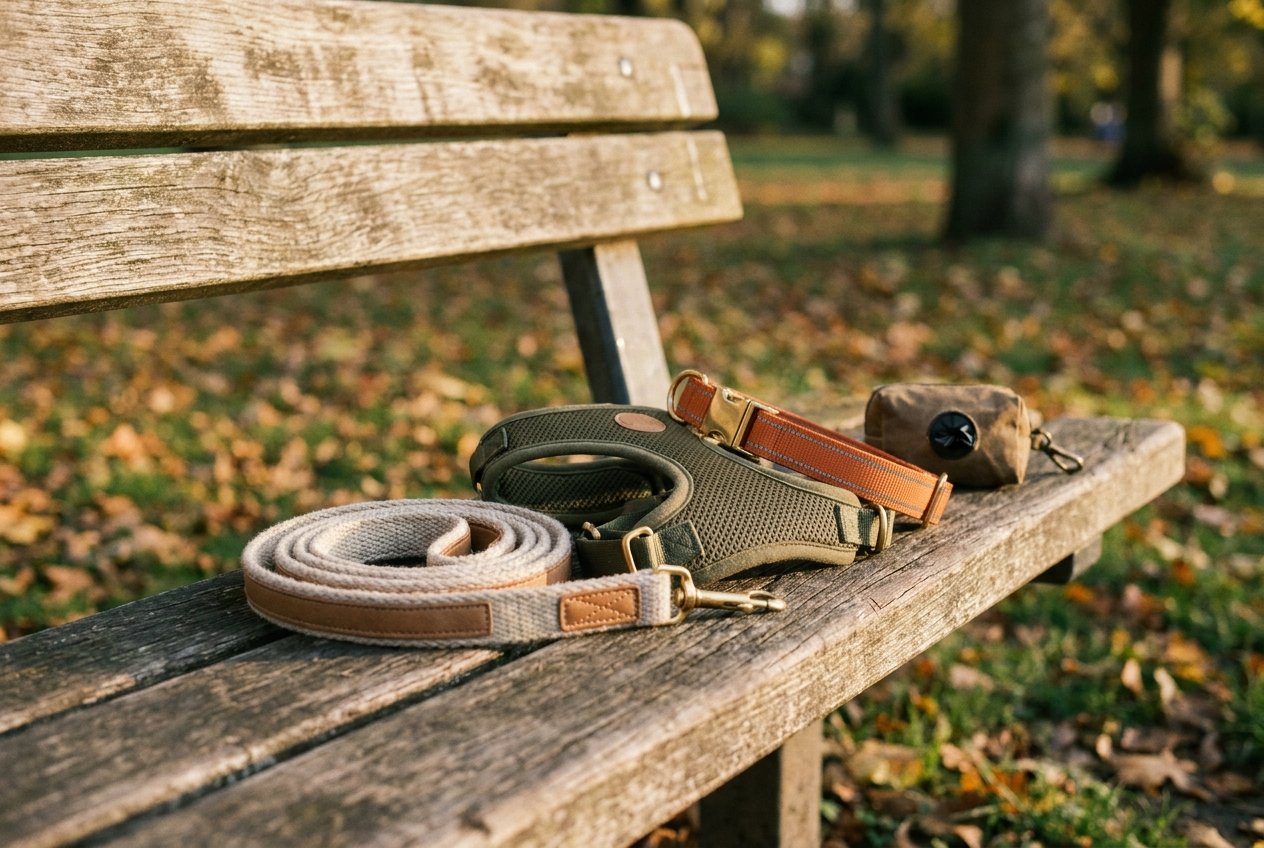
The walk is the most important moment of a dog's day, and often the most neglected when it comes to gear. People rely on the first leash they find, a collar bought by eye, a harness in the wrong size — and then wonder why the dog pulls, slips its head out, comes home cold. Choosing leash, harness and collar well is not a matter of looks: it is comfort, safety and control for both ends of the leash. This guide gathers the concrete criteria that really count, the most common mistakes and a real selection from the Dedal catalogue — accessories tested, documented, useful.
1. Harness or collar: the first fork in the road
It is the question everything starts from, and it has no single answer. The collar is light, always worn, handy for attaching the ID tag and for dogs already trained to the leash that do not pull. It has a limit, though: all the force of a jerk concentrates on the neck and windpipe, which can be problematic for dogs that pull or for brachycephalic breeds.
The harness spreads the pull across the chest and shoulders, sparing the neck. It is the recommended choice for puppies, dogs that pull, small and delicate breeds and anyone who wants to reduce pressure on the throat. In exchange, it asks for a little more attention in measuring and in putting it on and off. In general: collar for identification and dogs calm on the leash, harness for control and for pullers. Many owners use both, alternating according to the situation.
2. How to measure the dog (without getting the size wrong)
The single most common mistake is choosing the size "by eye". Dogs of the same breed vary a lot, and the size of a harness or collar is not deduced from weight but from measurements. You need two numbers and a soft tailor's tape.
For the collar: measure the neck circumference where the collar will sit, and add the room of two fingers between collar and coat. An adjustable collar, like the adjustable Hunter Inari collar 30-45 cm, forgives small errors and keeps up with a young dog's growth. For the harness: measure the chest circumference at its widest point, just behind the front legs, and if needed the neck circumference. The measurements shown on products — for instance the Red Dingo Style harness 25-39 cm for small sizes or the Hunter Hilo-Comfort harness 48-55 cm for medium sizes — refer precisely to these circumferences. When in doubt between two sizes, choose the one that allows more adjustment.
The two-finger test applies to everything: two fingers should pass comfortably between the accessory and the dog's body. If only one fits, it is tight; if three or four fit, the dog can slip out — and that is how the most dangerous escapes happen.
Puppy, adult, senior: different needs
A dog's age changes the priorities. A puppy needs light, highly adjustable gear and short, frequent outings: it grows fast and a harness should be rechecked often. A healthy adult dog has the most room to choose, and here comfort and material durability for daily outings matter most. The senior dog, finally, returns to delicate needs: it prefers soft padding that does not press on the joints, leashes that do not force abrupt movements and shorter but regular walks. A good accessory accompanies the dog through every stage, but the right size and stiffness for a puppy are not the right ones for a senior.
3. The harness: the types that matter
Not all harnesses are the same, and the shape decides comfort and control. Y-shaped harnesses leave the shoulder free and are the most respectful of natural movement, ideal for active dogs and long walks. H-shaped or padded mesh harnesses, like the breathable-mesh Hunter Hilo-Comfort, distribute pressure well and stay cool even in summer thanks to the airy fabric. For small dogs, a light, decorative harness like the Red Dingo Style combines comfort with a secure back attachment.
Watch the attachment point: a back-clip harness is the most common and comfortable for dogs that do not pull; a front-clip on the chest instead helps manage dogs that pull, because it redirects the thrust. If your dog pulls a lot, the front clip is an ally even before training.
4. The collar: when it still makes sense
The collar is not outdated: for an adult, trained dog that walks to heel, it remains the simplest and lightest solution. It is also the natural support for the ID tag — which, in many contexts, is legally required. Neoprene or padded collars are more comfortable than rigid nylon ones, and adjustable ones keep up better with variations. The golden rule stays the same: two fingers of play, never more. A collar that spins freely around the neck is a collar to tighten.
5. The leash: fixed, adjustable or retractable
The leash is the channel of communication between you and the dog, and the choice radically changes the walking experience.
The fixed leash
The classic fixed leash, usually 120 to 200 cm, is the simplest and safest. It gives direct control, has no mechanisms that jam and communicates a clear limit to the dog. A reflective model like the reflective Red Dingo leash 120 cm is the ideal choice for the city and evening outings, when visibility counts. For those who want more range in open spaces without giving up control, a sturdy classic leash like the Gloria CLASSIC is a good daily all-rounder.
The retractable leash
The retractable leash, with a tape or cord that reels back in, gives the dog freedom to explore while keeping the connection: a retractable leash like the Flexi Design size L is made for open spaces and reliable dogs. It must be used with judgement, though: it is not suited to city traffic, where the variable length reduces immediate control, and it requires a firm grip on the brake. It is a tool of freedom, not of distraction.
The basics of leash manners
No accessory replaces a little training, but a few principles make every walk calmer. First: the leash is not a steering wheel, you do not drive the dog with jerks. When it pulls, stop and set off again only when the tension eases — this way the dog learns that pulling does not move things forward, it stops everything. Second: rewarding the dog when it walks beside you, with a treat or a word, teaches far faster than punishing when it gets it wrong. Third: consistency beats intensity. Five minutes of calm, coherent walking every day build more than an occasional, nervous hour. A front-clip harness, as we have seen, helps meanwhile to manage the thrust without straining the neck.
6. Materials and fastenings: what lasts over time
Nylon is cheap, tough and washable, but can irritate if rigid and in direct contact with the coat. Neoprene and mesh padding are more comfortable and stay soft even when wet. Reflective fibres sewn into the fabric add no weight but change evening safety. Real durability plays out on the fastenings: quality plastic buckles are light and practical, metal ones last longer and do not fear dogs that nibble. Always check that the snap hooks are solid and that the stitching is dense and even: that is where a cheap accessory betrays you, usually at the worst moment.
7. Safety and visibility
Much of walking, especially in winter, happens in low light. Reflective inserts on leash, collar and harness are not an aesthetic quirk: they make the dog visible to drivers from dozens of metres away. If you often walk at dawn, dusk or night, prioritise reflective accessories — the reflective Red Dingo leash is made exactly for this. Also make sure the tag with your contacts is always legible: it is the cheapest insurance against loss.
8. Walking two dogs
Anyone with two dogs knows the problem: two leashes crossing, knotting, turning the walk into a tangle. A double coupler for two dogs like the Gloria connects two dogs to a single main leash, with an adjustable part that gives each a little autonomy without tangling. It works best with dogs of similar size and pace; for dogs very different in strength and speed, two separate leashes remain more manageable.
9. Cold and coats: when they are really needed
The dog coat divides opinion: some find it a frill, some genuinely need it. The truth lies in the dog. Short-haired breeds, small dogs, seniors and puppies struggle to hold heat, and in winter a padded, waterproof coat like the Trixie Pontis coat is not a frill but real comfort on cold, rainy outings. Nordic double-coated breeds, on the contrary, do not need one and may suffer the heat if covered. The size is taken along the back length, from the base of the neck to the base of the tail: a coat that is too long gets in the way of the dog's needs, one too short does not protect.
The weather changes the walk
Cold is not the only enemy. In summer, tarmac scorched by the sun can burn the paw pads: the practical rule is to rest the back of your hand on the pavement for five seconds — if it burns you, it burns the dog, and it is best to move the outing to the cool hours of morning or evening. Also in summer, always carry water on long walks. In winter, instead, the de-icing salt scattered on pavements irritates the pads: rinsing the paws on returning avoids discomfort and licking. Adapting times and gear to the season is not fussiness: it is the difference between a walk that does good and one that tires.
10. The accessories everyone forgets
There is one accessory nobody puts on the wish list and then uses every day: the bag dispenser. A bag holder like the Hunter dispenser clips to the leash and means you never head out without the means to pick up — an act of civility even before an obligation. Add a foldable water bottle for long summer outings and a few treats in your pocket to reinforce recall: they are the small details that make the walk smoother.
The long walk: what to bring
The block loop is one thing, the half-day hike another. For long walks it pays to think like a trekking backpack: water and a foldable bowl, a few high-value treats to keep motivation up, the ever-present bags gathered in the dispenser clipped to the leash, and a sturdy leash, better with a padded handle, because hours of walking are felt on the holder's hand too. If the route crosses roads or poorly lit areas, reflective inserts become indispensable. There is no need to overload: the essentials are enough, chosen before setting out rather than regretted halfway.
11. Maintenance and hygiene
Leashes, collars and harnesses get dirtier than we think: mud, saliva, rain. Most nylon and mesh models can be hand-washed with lukewarm water and mild soap, or machine-washed inside a pillowcase to protect the buckles. Always air-dry, never on the radiator, so as not to harden the fabrics. Check the stitching and attachment points now and then: a worn accessory should be replaced before it fails, not after. A clean, intact harness lasts years; a neglected one wears out in a season.
12. The most common mistakes
The first is the wrong size, almost always too loose "to be comfortable": it is the number-one cause of escapes. The second is using a retractable leash in the city, where immediate control is needed. The third is leaving the collar too loose thinking it is kind to the dog. The fourth is neglecting visibility on evening outings. The fifth is choosing only by colour or price, ignoring fastenings and stitching — that is, precisely the parts that decide whether an accessory will hold the jerk at the wrong moment.
And the cat?
Cats go out too, and different rules apply to them: never a fixed collar that does not give, but models with a safety clasp that opens under tension to prevent strangulation if the cat gets caught. A cat collar like the Red Dingo Modern is designed exactly with this safety logic. For leash walks, the cat always goes in a harness, never on the collar.
Mini-FAQ
My dog pulls: harness or training? Both. A front-clip harness helps manage the thrust straight away, but it does not replace work on leash manners. It is a tool that makes training easier, not an alternative to it.
How often should I recheck a puppy's size? Every few weeks in the first months: puppies grow fast and a harness that fit at two months pinches at four. Highly adjustable models are best at this stage.
Snap hook or spring clip — which is better? Solidity matters, not the type. Check that the mechanism closes with a clean click and that the spring is robust: that is the point holding all the pull.
Does a retractable leash harm the dog? Not in itself, but it teaches pulling and should be avoided with a rigid collar (the jerk concentrates on the neck). Better to pair it with a harness and use it only in open, safe spaces.
How long should a walk last? It depends on size, age and breed, but the general rule is little and often beats a lot and rarely: two or three outings a day, even short ones, cover the physiological needs and give the dog the stimulation that a single long walk does not replace. For energetic dogs, add play and sniffing: the walk is mental before it is physical.
The selection
The essential walking kit, all from the Travel and Walking category of the Dedal catalogue:
- Hunter Hilo-Comfort mesh harness 48-55 cm — comfort and breathability for medium sizes.
- Red Dingo Style harness 25-39 cm — light and secure for the small ones.
- Hunter Inari adjustable collar 30-45 cm — simple, comfortable, adjustable.
- Red Dingo reflective leash 120 cm — control and evening visibility.
- Flexi Design retractable leash L — freedom in open spaces.
- Gloria double coupler for two dogs — two dogs, one leash, zero knots.
- Trixie Pontis coat — real warmth on cold outings.
- Hunter bag dispenser — the accessory you never forget again.