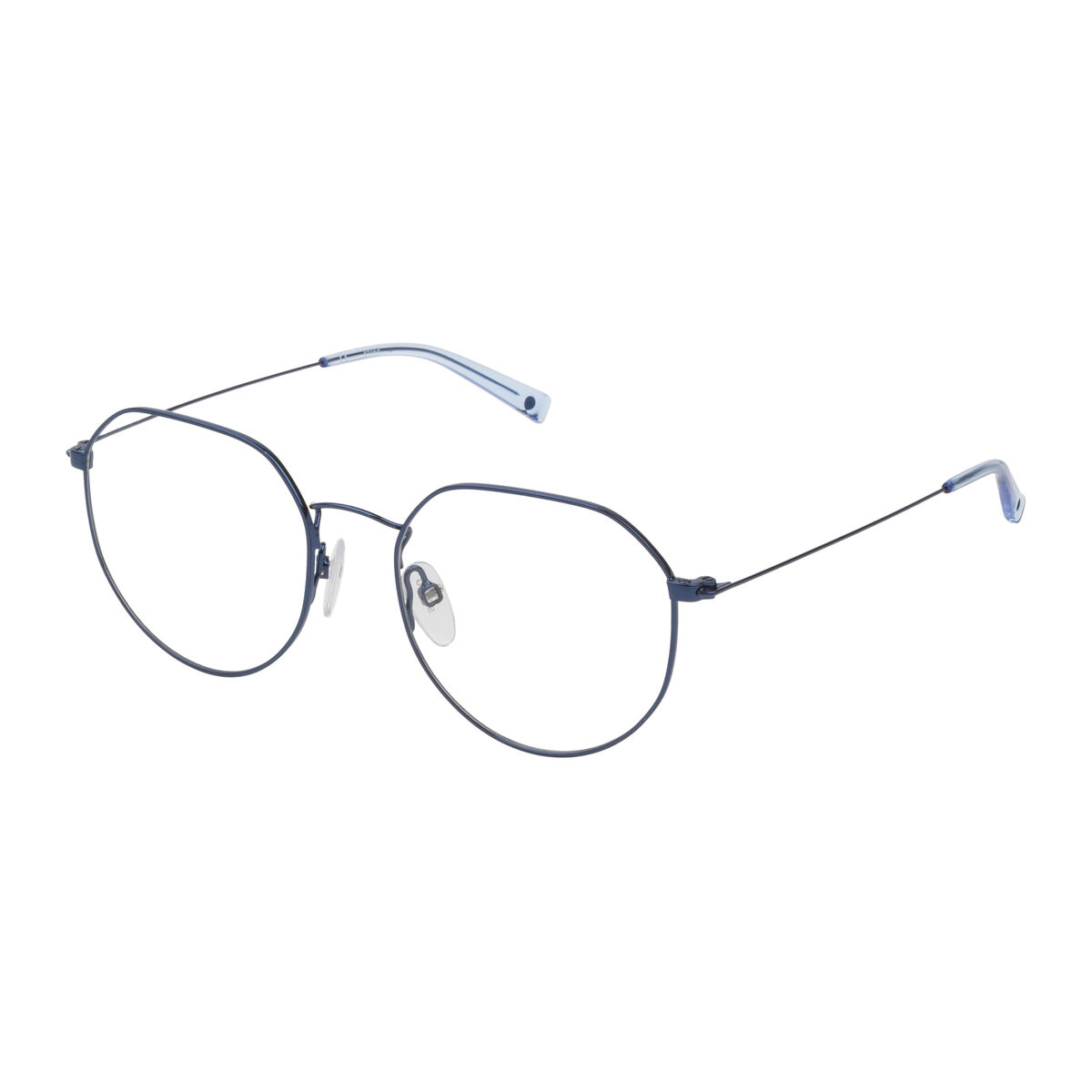
Almost every guide to eyeglass frames starts with face shape: oval, square, heart, and off we go with the matching chart. It is the most quoted criterion and the least useful, because it never explains why one pair slides down your nose, why another leaves a mark behind your ears, why a third has a wobbling temple after six months. None of that depends on face shape: it depends on three numbers printed inside the temple, on the material, and on how the hinge is built. This guide starts there.
One clear premise first, because it is the most important thing here: the frame is only half the object. Lenses, prescription and centring are the work of an optician and an optometrist, and no article — this one included — replaces an examination and measurements taken in person. What follows is about the frame: how to read its measurements, how to recognise a build that lasts, how to make it sit where it should.
1. The frame is not the lens
Buying a frame and having your own lenses fitted is a normal, widespread practice, and it is why frames are sold on their own. But the division of labour should stay clear. The frame decides how the object sits on your face, how much it weighs, how long it lasts and how it looks. The lens decides what you see, and that is decided by a professional on the basis of an up-to-date prescription.
This means two practical things. First, a frame bought online still goes to the optician, who will measure it on you and fit the lenses: that step is part of the plan, not a fallback. Second, if you notice changes in your vision — at any age, and particularly if close-up reading has become tiring — the answer is not a new frame, it is an eye examination.
What to bring to the optician
Three things make the visit quick and the result better. The up-to-date prescription, with the values for each eye. The glasses you wear now, which tell the optician far more than you would think: where they rest, where they have deformed, how far the lenses sit from your eyes. And, if you have already chosen the frame, the frame itself, because some measurements — pupillary distance against the chosen shape, the usable lens height — are taken on the real frame and not on a generic model.
A detail few people know: if you wear progressive lenses, the frame needs enough vertical lens height, generally at least twenty-eight or thirty millimetres. Very slim, elongated shapes, however elegant, may simply not contain all the zones of a progressive. That is the first question to ask, before falling in love with a model.
2. The three numbers on the temple
Open the glasses you wear now and look at the inside of the temple, or the bridge. You will find a sequence like 52-18-140, sometimes written with a small square instead of the first dash. These are the three numbers that matter more than anything else, and they are in millimetres.
The first is the lens width: the horizontal width of one lens. The second is the bridge: the distance between the two lenses, the space that passes over your nose. The third is the temple length, from the hinge to the tip that drops behind the ear. Lens width plus bridge determines how wide the frame is overall, and therefore whether the lenses will fall in front of your pupils or sit shifted outwards.
How to actually use them
The most reliable method isn't measuring your face: it's starting from a pair that already fits. Take the numbers from your best glasses and look for frames within one or two millimetres on each measurement. A two-millimetre difference in lens width is barely noticeable; four change the frame visibly; six make it a different object.
The bridge is the number most often ignored and the one that decides whether your glasses slide. A bridge that is too wide rests badly and drops; one too narrow pinches and leaves a mark. On metal frames, adjustable nose pads forgive a few millimetres of error; on acetate frames with an integrated bridge the margin is almost nil, because the bridge is the shape itself.
Temple length, finally, decides whether the frame presses behind your ear. Common measurements are 135, 140 and 145 millimetres. A temple that is too short pushes the frame forward and makes it rest badly; one too long leaves the glasses free to slip with every movement of your head.
3. Materials: what really changes
Cellulose acetate is the material of thick, coloured frames. It is milled from sheets, takes deep colours and gradients that moulded plastic cannot imitate, and above all it can be heated and reshaped by an optician: the most adjustable material there is. In exchange it weighs a little more than metal and, over years and perspiration, can lighten slightly.
Metal covers everything else. Stainless steel is light, resistant and by far the most balanced choice for price against durability. Titanium weighs even less, doesn't corrode and is practically eternal, but costs more and is harder to weld if repair is needed. Beta-titanium, elastic, is used for temples that must flex without deforming. Monel, very common in budget ranges, is softer and tends to give way sooner at the stress points.
Weight, skin and daily use
Weight matters more than people think, because it accumulates over twelve hours. A thick acetate frame can weigh thirty grams, a slim titanium one under fifteen: the difference isn't felt in the shop and is felt very clearly at six in the evening. If you wear glasses all day, weight is as much a criterion as looks.
If you have had trouble in the past with costume jewellery or metal buckles, mention it to the optician before choosing: there are materials and finishes made for that sensitivity, and the choice is made at the start, not afterwards. The same applies to anyone working in humid or hot environments, where cheap finishes dull faster.
4. Proportions and face: the rule that beats the clichés
Forget the shape chart and three practical references remain, and they work on anyone. First: the frame shouldn't exceed the width of your face at the temples. If the arms splay outwards before bending, the frame is too narrow; if your face sits inside the outer edge, it is too wide.
Second: your pupils should fall roughly at the centre of the lenses, slightly above the midline. That is the criterion separating a frame of the right size from one that is merely pretty. Third: the top line of the frame tends to follow the line of the eyebrows, and the frame shouldn't touch your cheeks when you smile — if it does, it will drop and smudge constantly.
Beyond that, the margin is wide and personal. A thicker frame gives presence and hides the lens edge better with stronger prescriptions; a slim metal one disappears. Round shapes soften straight lines, squared shapes give structure: useful observations, not rules, and the only way to check them is to look at yourself wearing the frame.
5. Hinges, nose pads and tips: where a frame lives or dies
The hinge is the point that breaks. There are three families. The classic screw hinge, with two or more interlocking elements, is simple, repairable and reliable as long as the screw stays tight — checking it every couple of months with a watchmaker's screwdriver prevents almost every problem. The flex hinge, with an internal spring, lets the temple open past ninety degrees: more comfortable, more forgiving, slightly more complex to repair. The screwless snap hinge, typical of some minimalist frames, is elegant and should be judged case by case.
Nose pads, on metal frames, are the part that wears fastest. They are silicone or acetate, they get dirty, yellow and harden: an optician replaces them in minutes and they cost little. It is the intervention that most often makes a three-year-old pair look new. On acetate frames the bridge is fixed, which is why bridge size becomes critical at the moment of purchase.
Tips and how the glasses stay on
The end of the temple, the part dropping behind the ear, follows two philosophies. Straight or barely curved tips, typical of light frames, rest without gripping and suit people who take their glasses on and off often. More curved tips wrap the ear and hold the frame still even in movement: the choice for people who walk, cycle or bend over frequently.
Almost all metal and acetate temples can be heated and reshaped by an optician. If your glasses slip, before replacing them it's worth asking for an adjustment: five minutes of work solves most cases, and it is often free where you bought the lenses.
6. Refurbished frames: what it actually means
The catalogue shows frames marked as refurbished followed by a letter. That is useful information, not a warning to avoid: it means the item has been checked and graded by cosmetic condition, on a scale running from nearly new to visible signs of use.
The buying logic is simple. A higher letter means better condition and a price closer to new; a lower letter means more visible cosmetic marks and a bigger saving. What doesn't change is the structure: the frame must be sound, with working hinges and aligned temples. For a frame that will receive new lenses anyway, a few micro-scratches on the temple are a trade-off many people happily accept.
The practical advice is to reserve refurbished for the second pair, the one kept at the office or in the car, and new for the main pair. Or the opposite, if the model you want is no longer in the catalogue: refurbished is often the only way to find again a discontinued frame you had grown attached to.
7. How many pairs you actually need
A single pair of glasses is a point of fragility: if it breaks, the day stops. Anyone wearing glasses all day should think in terms of contexts, not identical spares.
The main pair is the one you choose most carefully, with the best lenses and the most comfortable frame. The second pair lives where you'd want one: the office desk, the bedside table, the backpack. It needn't be identical — in fact it's better if it isn't, and this is often where refurbished or a cheaper frame find their purpose.
If there are children at home the reasoning changes: for them a second pair isn't a luxury but the norm, because breakage is a matter of when, not if. Children's frames are chosen on their own criteria — flexible materials, temples that hold, sizes suited to a growing face — and the choice is made with the optician, who will check the fit on the face.
8. The most common mistakes
The first is choosing while looking in a close-up mirror. At thirty centimetres any frame looks large: look at yourself at arm's length, or take a photo, because that is how other people see you.
The second is ignoring the bridge, as we've seen. The third is choosing a shape that is too shallow if you wear progressives, and discovering it only at fitting. The fourth is buying two identical pairs: it looks prudent, but if the size is wrong the mistake is doubled.
The fifth concerns promises. Frames don't correct vision and no lens treatment replaces a check-up: if reading is an effort, if your eyes burn in the evening, if close focus has changed, the sensible thing is to book an eye examination. It is the one piece of advice in this guide worth more than all the rest together.
9. Cleaning, care and seasonality
There is only one way to clean glasses: lukewarm running water, a drop of neutral soap, rinse and dry with a clean microfibre cloth. Rubbing dry lenses with your shirt is the fastest way to scratch them, because the dust already on them acts as an abrasive. For the same reason the microfibre cloth should be washed now and then, otherwise it holds exactly what it is meant to remove.
Single-use wipes have a precise purpose: away from home, when there is no water. Anti-fog versions solve the most annoying seasonal problem — going from cold to warm, kitchen steam, a face mask — and should be used on already-clean lenses, because they leave a thin film that needs a clear surface.
A few other habits extend a frame's life. Take it off with both hands, never one, because that single gesture misaligns temples more than any drop. Store it in a hard case with the lenses facing up. Never leave it on a car dashboard in summer: heat deforms acetate permanently. And have the alignment checked once a year, along with tightening the screws.
On seasonality, two notes. In autumn, with heating and dry air, fogging becomes a daily event and that is when wipes belong in your bag. In summer, perspiration and sunscreen attack nose pads and finishes: more frequent rinsing and a pad replacement at the end of the season cost very little and show.
10. Quick questions
Can I buy the frame online and have my lenses fitted? Yes, it's a normal practice. The optician will measure it on you and fit the lenses to your prescription.
How do I find my size without leaving home? Read the three numbers inside the temple of the glasses you wear now and look for frames within a couple of millimetres.
Acetate or metal? Acetate is more adjustable and has more character; metal is lighter and more discreet, with nose pads that forgive a few millimetres. It's a comfort choice before a style one.
Are refurbished frames worth it? If the structure is sound, yes: the letter refers only to cosmetic condition. They're an excellent choice for a second pair or to find a discontinued model again.
How often should glasses be replaced? The frame lasts as long as it stays aligned and the hinges hold, often many years. Lenses depend on the prescription, and that is set by an eye examination, not the calendar.
The picks
A few real products from the category to start from, each for a different need:
- Sting VST223510F45 unisex frame — essential lines, a good starting point
- Fila VF9919-0627 men's frame — sporty build for everyday wear
- Furla VFU675-540302 women's frame — for those wanting a frame with character
- Tods TO5007088 men's frame, blue — discreet colour, sober shape
- Tous VTK010500A47 children's frame — sizes made for a small face
- Carrera CA 2039T_CS women's frame (refurbished D) — refurbished, for the second pair
- Guess GU50114 55089 women's frame (refurbished C) — better condition, contained price
- Anti-fog wipes, pack of 50 — for the months when lenses fog up