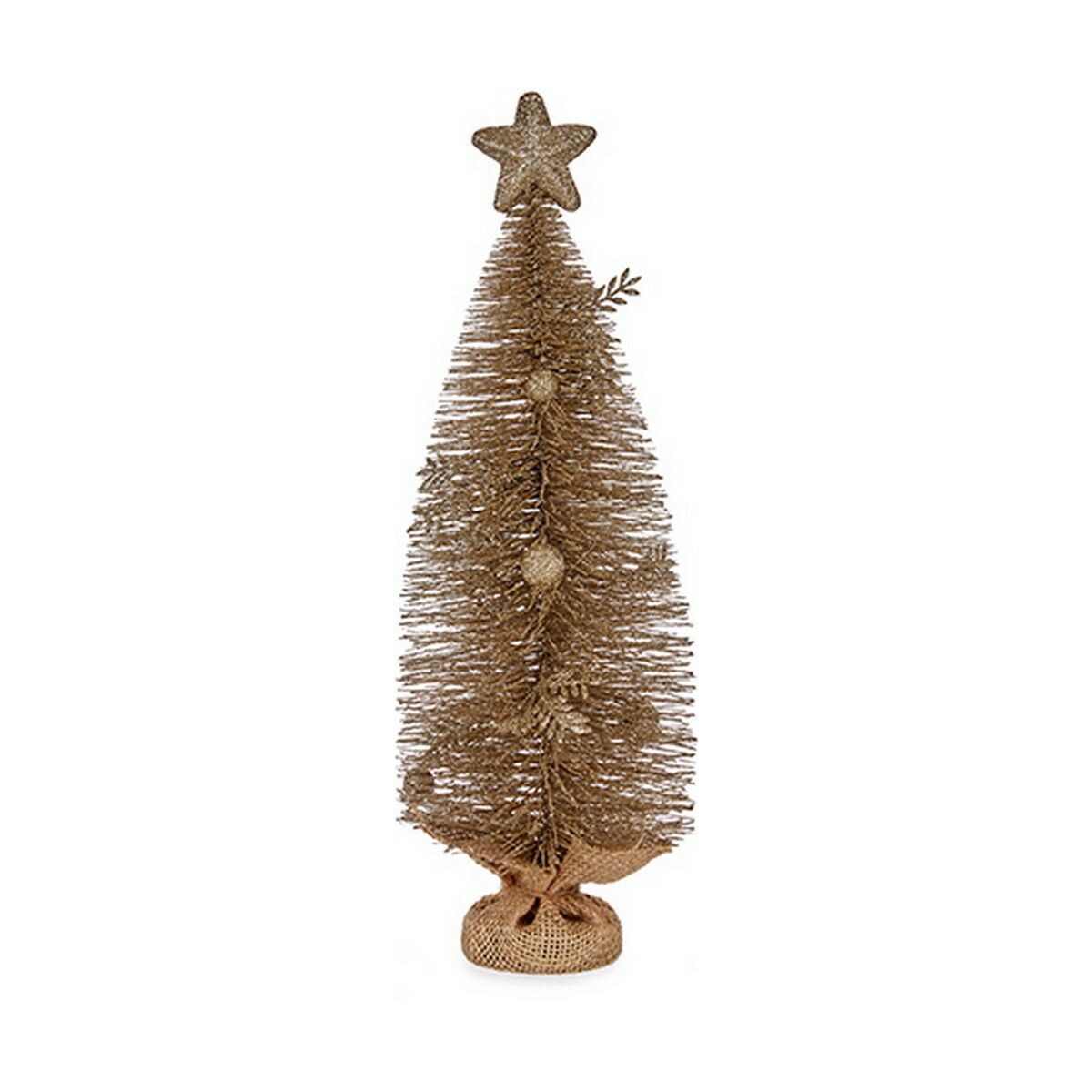
Christmas decoration is the only furnishing we buy in a hurry, put up in an afternoon, take down with irritation and buy again the following year because half of it broke and we no longer like the other half. It is a cycle that costs money, space and patience, and it is almost entirely avoidable. A home that looks good in December does not come from a generous purchase on the first weekend of Advent: it comes from a palette chosen once, from a few well-made objects and from a way of storing them that gets them intact to the following January. This guide is about how to get there, and about what to look for in the catalogue so you do not start from scratch every year.
The Christmas decoration category on Dedalshop gathers tabletop trees in metal and wood, reindeer and figures, baubles in sets of fifty, tapered hanging ornaments, themed pendants. They are simple objects, and precisely for that reason they are chosen better with a few criteria: the differences between a set that lasts and one that ends up in the bin on Boxing Day do not show in photographs, but they are easy to recognise if you know where to look.
1. Palette first, everything else after
The most common mistake is not buying too much: it is buying without a thread. A red bauble here, a gold one received as a gift, a string of cool-white lights and a warm one, a green tree, a white one. The result is an ensemble that always looks untidy however much you move and adjust it. The solution costs nothing and comes before any purchase: choose two dominant colours and one metal, and do not leave that trio for at least three years.
The combinations that work effortlessly are few and well proven. Deep green and gold with natural wood is the most classic and the most tolerant: it accepts red in small doses and suits almost every home. White, silver and ice blue is the winter palette, luminous, suited to bright modern rooms. Copper, dusty pink and champagne is the warm contemporary choice, which gets on well with pale wood and neutral walls. Anthracite with gold or silver is the most restrained, and the best for anyone who wants the decorations to converse with dark furniture rather than shout over it.
How to use the palette in the catalogue
Once chosen, the trio becomes a filter. In the catalogue the tabletop trees exist in silver, gold, anthracite, pink and champagne; the tapered ornaments in red, copper and silver; the baubles in green and silver. You do not need to buy everything in a single shade: you need every object to belong to the trio. A champagne tree with copper and pale pink ornaments is an ensemble; the same tree with green baubles and a red pendant is leftover stock.
2. Materials: what lasts and what breaks
The material decides how long a decoration lives, and explains most of the price difference. Metal is the longest-lived: a silver or gold metal tabletop tree does not chip, does not yellow, does not mind the damp of a cellar and, if the finish is good, stays identical for ten years. It is the right choice for the structural objects that return to the same place every year: the centrepiece, the hallway, the mantelpiece.
Wood is warm, light, quiet to the eye. A gold-finished wooden tree or a pale wooden reindeer give the ensemble that Nordic note that makes even a full room feel calm. The limits are two: wood dislikes damp, so the box in the cellar must be dry, and painted finishes scratch if stacked without protection. With a sheet of tissue paper between one piece and the next, wood lasts as long as metal.
PVC, plastic and the question of glass
PVC and plastic are the materials of baubles in quantity and of hanging ornaments. They do not break when they fall, weigh little and cost little: they are the obligatory choice where there are children, pets, or where the tree is tall and ornaments fall. Quality shows in three details: the hook, which should be metal and not thin plastic that snaps in the second year; the finish, which on cheap products scratches on contact with other baubles and needs protecting in compartment boxes; and the colour, which in good PVC is uniform and does not show through against the light. Glass, almost absent in this category, remains the choice for anyone who wants deep reflections and is willing to treat every piece with care.
3. Proportions: the rule that fixes almost everything
After the palette, the second reason a scheme looks wrong is scale. Small decorations on large surfaces get lost; large objects on small surfaces suffocate. The practical rule is that each surface hosts one dominant object and at most two complements, and that the dominant object occupies between a third and half of the visible surface.
Tabletop trees are the perfect example. A twenty-five-centimetre tree looks right on a bedside table, a desk, in a bathroom; on a dining table it disappears. A forty-six-centimetre tree with a star is the centrepiece of a table for six or the object on a hallway console, and is enough on its own. A one-metre reindeer is a presence: it belongs in the corner of a living room or beside a fireplace, not on a cabinet. Measuring the surface and imagining the object to scale before buying avoids almost all returns.
Eye level and viewpoints
Decorations are looked at from a sofa in the living room, standing in the hallway, from above at the table. A tabletop tree on a low cabinet is seen from above, so the shape of the cone matters; on the mantelpiece it is seen head-on, and the silhouette matters. Tapered hanging ornaments work when they hang freely and catch the light: on a branch, a handle, at a window, not resting on a surface.
4. Lights: temperature, quantity and safety
Lights are ninety per cent of the atmosphere and the first thing to decide together with the palette. Colour temperature is the criterion nobody looks at and everybody perceives: warm light, around 2700 kelvin, is candlelight and suits gold, copper, wood and green; cool light, above 4000 kelvin, is snow light and only holds up with silver, white and ice blue. Mixing the two temperatures in the same room is the most visible mistake you can make, and also the easiest to avoid: buy everything in a single temperature, for ever.
Quantity is the second decision. The common rule for a tree is one hundred lights for every thirty centimetres of height; for a shelf or a centrepiece, a string of twenty or thirty battery micro-LEDs is more than enough. Battery lights are the right choice for tabletop trees, vases and spots far from sockets; mains lights with a timer for the main tree and for outdoors, where cables and transformers certified for damp are needed.
What must never be done
Old incandescent lights get hot and should be replaced; LED strings use a fraction of the power and stay cool. They should never be left on overnight without a timer, never run under rugs, never chained beyond the number stated on the box, never used outdoors unless expressly designed for it. Metal decorations should be kept away from cable contact points. These are banal rules, and they are the ones that matter.
5. The tree: real, artificial or tabletop
A real tree smells wonderful, sheds, makes a mess, dries out and ends up in the green waste in January: it is a choice of ritual more than practicality, and for anyone making it, only worthwhile with a stable stand and water every day. A large artificial tree is a ten-year investment that occupies a cupboard, and its quality lies in branch density and in its shape after the third year. But the most interesting trend of recent years is the tabletop tree: in metal or wood, twenty-five to fifty centimetres tall, often already decorated or with an integrated star.
The tabletop tree solves three problems at once. It fits in a small home or a flat with no room for a real tree. It fits in a home with small children or cats, where a big tree is a daily challenge. And it allows several decorated spots instead of one: one in the hallway, one in the kitchen, one in the bedroom. Two or three tabletop trees in the same palette, of different heights, create a more coherent atmosphere than a big tree half decorated.
How to choose one
A metal tabletop tree should be examined at the base: it must be heavy or wide enough not to tip when brushed. The gold or silver finish should be uniform and without smears at the welds. In wooden models the joints between pieces must be clean and the edges smooth. If it has a star or integrated decorations, they should be fixed rather than merely glued. The dimensions in the listing should be read in full: 23 x 14.5 x 46 centimetres means twenty-three wide at the base and forty-six tall, and the deciding number is the first, because it determines the space on the table.
6. Order of assembly: the method that saves two hours
Decorating in the wrong order is why you end up moving everything three times. The right order is always the same: lights first, then structural elements, then small decorations, finally details. On the big tree the lights go on from the inside of the branch outwards, spiralling from the bottom, before any decoration. Then ribbons or bead strings, if any. Then large baubles towards the inside and bottom, small ones towards the outside and top: that is the arrangement that gives depth. Tapered pendants and figures go last, distributed so that every viewpoint sees one or two, not a cluster.
On surfaces the logic is identical in miniature: first the battery light, hidden behind or underneath; then the dominant object, the tree or the reindeer; then at most two complements, a bauble resting or a pendant on a twig. And then stop. The temptation to add is the enemy of the scheme, and the best rule is to remove one object after finishing.
7. Use cases: four homes, four schemes
The small flat. No big tree. A forty-centimetre tabletop tree as the centre, a second small one in the hallway, warm battery lights, tapered ornaments at the window. One palette, three colours. Everything fits in a large shoebox in January.
The home with children and pets. PVC and plastic baubles, never glass. Tabletop tree on a high cabinet, or a big tree decorated only from one metre up in the first year. Reindeer and figures in wood or metal that survive falls. Battery lights with a screw-closed compartment.
The large home with guests. The main tree in the living room, and then a thread connecting the spaces: the same metal and the same light in the hallway, the dining room, on the stairs. The Christmas centrepiece, a tree with a star or a composition of baubles in a low bowl, is what guests look at longest.
The office or shop. Few large objects, well distributed, in a palette that does not clash with the brand: anthracite and gold or white and silver. Metal decorations last years and clean with a cloth; a one-metre reindeer at the entrance is worth more than a hundred small decorations.
8. Storage: where decorations die
Most decorations do not break at Christmas: they break in January, in the wrong box, and you find out in December. Storage is the most neglected step and the one that decides whether the investment lasts three years or ten. The principle is simple: every object has a space of its own, does not touch the others, and sits somewhere dry and not too warm.
Baubles go in compartment boxes, one per cell, or in the original packaging if it has trays: fifty baubles in a bag are fifty scratched baubles. Tapered ornaments and pendants are wrapped individually in tissue paper and laid flat. Metal tabletop trees are kept in the original box or a rigid box with a sheet of paper between base and tip; wooden ones above all need a dry environment. Lights are wound around a piece of stiff cardboard, never in a hank, and checked before storing: a faulty string in January is a string to throw away, not to keep.
One label per room
The method that saves the most time the following year is one box for each spot in the home, labelled: hallway, table, fireplace, windows. Inside, the dominant object, the complements and the lights for that spot. In December you open the box and reassemble without thinking. It is an extra hour of work in January and three hours less in December.
9. Quick comparisons: the choices that divide
Big tree or tabletop trees? If there is room and the tree is a family ritual, big. If space is short, there are small children or you prefer several decorated spots, tabletop. Many homes do well with both: one big tree and two small ones in the same palette.
Metal or wood for figures? Metal where absolute durability and reflection are needed; wood where you want warmth and visual lightness. Together, in the same palette, they work very well.
Set of fifty baubles or single pieces? The set is the base: uniform, inexpensive, enough for a medium tree. Single pieces, tapered or figurative, are the details you add a couple of a year, always within the palette.
Battery or mains lights? Battery for surfaces, vases, tabletop trees and spots without a socket; mains with a timer for the big tree and outdoors. Both in the same colour temperature.
10. Seasonality: when to buy
The time to buy decorations is not December. From late September to October the catalogues are complete, choosing by palette is possible and the structural pieces, tabletop trees and figures, are available in every finish. By mid-November the most requested shades run out and you are forced out of the trio. In January prices fall, but the choice is whatever is left. The most rational strategy is to buy the base in autumn, in one go and in one palette, and add one or two pieces in January at reduced prices for the following year, always in the same colours.
The same applies to how long the scheme stays up: anyone who decorates on the first of December and takes down after Epiphany keeps the decorations out for five weeks, which is the period when dust settles on matt baubles and branches. A dusting halfway through, with a soft brush, keeps the reflections and avoids putting dust away in the box.
11. Quick questions
How many decorations does a tabletop tree need? Often none: many models are already complete. If you add any, five or six small ones in the same palette are enough.
Can I mix gold and silver? You can, but it is hard to make the choice look intentional. A single metal for at least three years is the safest rule.
Do PVC decorations yellow? Good-quality ones do not, if stored in the dark and away from heat. In a box in the attic under the roof, yes.
How do I clean metal decorations? With a dry or barely damp microfibre cloth. No detergents on gold or silver finishes.
How many lights for a centrepiece? One string of twenty or thirty battery micro-LEDs, hidden under or behind the dominant object, is enough.
The selection
Some real products from the category to start from, each for a different need:
- Krist+ Christmas Tree with Star, Champagne, 46 cm — the complete centrepiece, in the warm palette
- Krist+ Silver Metal Christmas Tree, 25.5 cm — for the bedside table, the desk and small spots
- Krist+ Gold Wooden Christmas Tree, 31 cm — the Nordic note, light and warm
- Krist+ Anthracite Christmas Tree — the restrained choice for dark furniture and offices
- Krist+ Pink Christmas Tree — for the copper, dusty pink and champagne palette
- Krist+ Christmas Reindeer, 1 m — the presence for a living-room corner or the hallway
- Krist+ Christmas Reindeer Brown Pink, 43 cm — the figure for a shelf or console
- Krist+ Silver Baubles Ø 7 cm, 50 pieces — the uniform base for the big tree
- Krist+ Green Baubles Ø 7 cm, 50 pieces — for the green and gold palette
- Krist+ Tapered Ornament, Copper Pale Pink — the pendant that catches the light at the window
- Krist+ Tapered Ornament, Silver — the same pendant for the cool palette
- Krist+ Snowflake Ornament, 17 cm — the detail for the white, silver and ice-blue palette