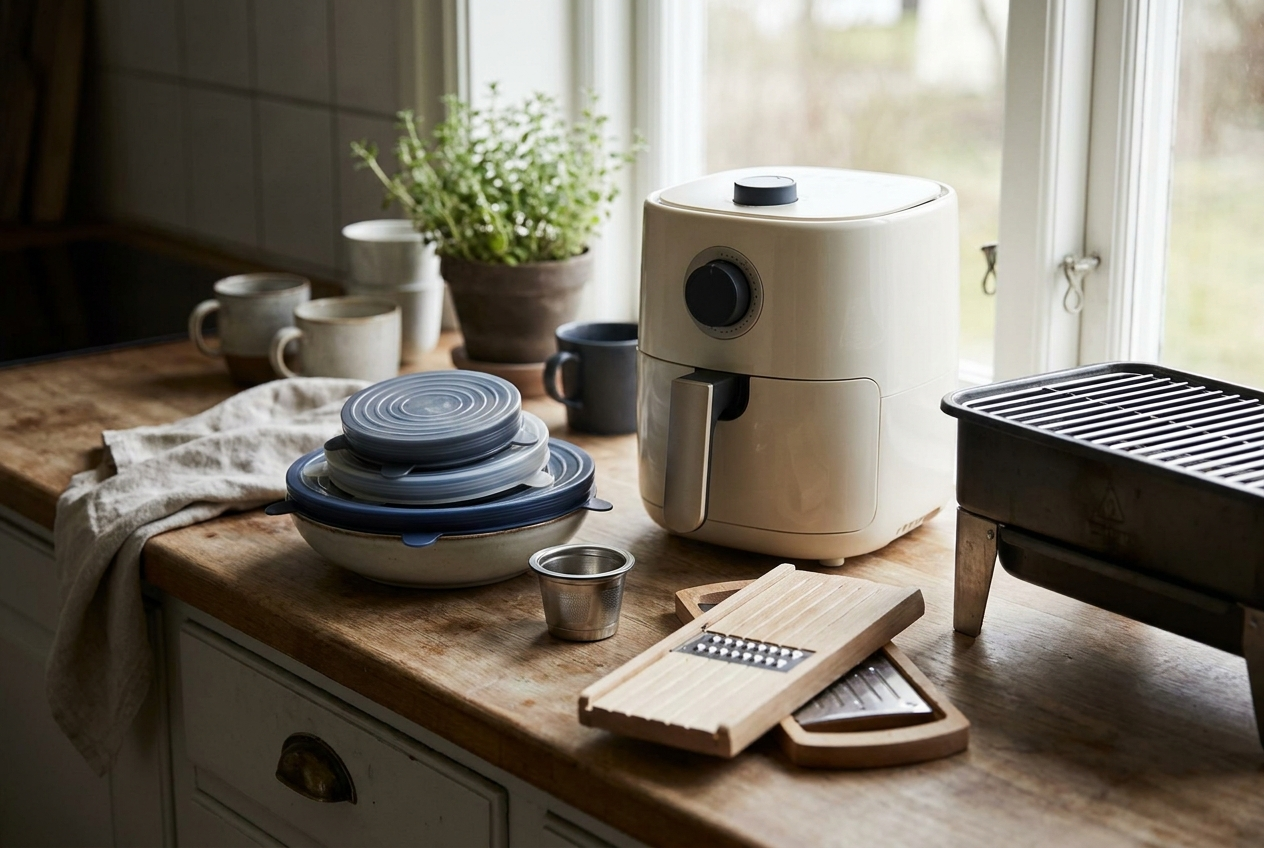
The kitchen gift that ends up forgotten at the back of a drawer almost always has the same flaw: it was chosen by looking at the object — how nice it looks, how much it costs, how useful it seems on the shelf — and not at the person who will actually use it, every day, in their real kitchen. A good kitchen gift isn’t the one that impresses when the box opens: it’s the one still within reach on the counter two months later. This is the framework we use to tell the two apart, with a real selection from the catalogue to make each criterion concrete.
1. Start from the person who cooks, not the object
The first mistake is thinking by category — «I need a kitchen gift» — instead of by person. The same air fryer is a perfect gift for someone who cooks in a hurry after work, and useless clutter for someone with a tiny kitchen who loves their cast-iron pan. Before choosing the object, try to answer just one question: how does this person actually cook, in an ordinary week?
The beginner
Someone who has just moved out or started cooking recently needs tools that remove friction, not chef’s gear. A 5-in-1 multifunction can opener or a folding mandoline grater solve small daily annoyances without demanding skill. They’re gifts that get used right away, and that’s already half the battle.
The enthusiast
Someone who cooks for pleasure already has the basics and is after the object that opens a new possibility: making pizza like a pizzeria, toasting bread over fire, baking cookies in batches. Here a pellet pizza oven or a cookie and piping machine aren’t gadgets: they’re the excuse for a whole afternoon in the kitchen.
Those with little space
In a small kitchen the dominant criterion isn’t function, it’s footprint. Something that folds, hangs or slips into a drawer is worth more than something more powerful that lives permanently on the counter. This is where folding formats and compact multifunction tools make the real difference, and where the wrong gift instantly becomes a problem to hide.
2. Manual tools or small appliances?
This is the first big fork. Manual tools cost little, need no power outlet, wash easily and don’t break: a good can opener or a solid grater lasts years and rarely fails. They’re the right gift when you don’t know the person’s habits well, because it’s almost impossible to get wrong: a well-made manual tool always finds its use.
Small appliances, on the other hand, promise more but also ask for more: a place to live, a free socket, the willingness to take them out and then clean them. Their value depends entirely on frequency of use. An air fryer used three times a week is one of the best possible buys; the same fryer used once a month just takes up the shelf. Before gifting an appliance, ask yourself honestly whether it will enter the recipient’s routine — not whether, in the abstract, it’s useful.
A smart middle ground is appliances that replace several objects at once. A model like the 12-in-1 air fryer with grill makes sense precisely because it removes clutter instead of adding it: you add one and remove three. It’s the opposite logic to the single-use gadget, and it usually pays off over time.
3. The materials that matter
In the kitchen the material isn’t an aesthetic detail: it decides hygiene, durability and safety. It’s worth learning to read three families before buying.
Food-grade silicone
Food-grade silicone withstands high and low temperatures, holds no odours, is flexible and dishwasher-safe. It’s the ideal material for lids, moulds, trivets and anything that must bend or adapt. A set of stretchable silicone lids is the perfect example: it replaces single-use film and foil, lasts years and cuts waste. The quality sign is firmness: silicone that’s too soft and sticky ages badly.
Stainless steel
For blades, can openers, graters and anything that must cut or endure, stainless steel remains the standard: it doesn’t rust, cleans well and keeps its edge. When gifting a cutting tool, check the steel is solid and firmly set into the handle — that’s where cheap objects give first.
Food-safe plastics
Plastics aren’t all equal. For containers and accessories in contact with food, it matters that they’re declared food-safe and, if they’ll go in the freezer or microwave, that they withstand those temperatures. This is where it’s worth spending two extra minutes reading the details: the right plastic is convenient and safe, the wrong one stains, holds odours and warps.
4. Multifunction: when it’s worth it and when it’s a trap
The «all-in-one» is the most seductive promise and the most treacherous. On one hand, a well-designed multifunction tool is exactly what a small kitchen needs: it does the job of three objects in the space of one. On the other, many «5-in-1» tools do five things badly instead of one thing well, and end up doing none.
The practical rule is simple: a multifunction tool is worth it when the functions are related and use the same gesture. A 5-in-1 can opener makes sense because opening jars, bottles and caps is all the same lever movement. A mandoline grater with several blades makes sense because cutting and slicing are the same gesture at different angles. Be wary instead when the functions have nothing to do with each other: that’s where the compromise makes everything worse.
A second criterion is cleaning. The more parts, joints and slots a multifunction tool has, the more annoying it becomes to wash — and an object that’s awkward to clean gets abandoned fast, however ingenious. Before gifting it, picture the washing-up moment: if it looks like a nightmare, it’ll be a short-lived gift.
5. Common mistakes when gifting for the kitchen
The first mistake, as we said, is choosing the object before the person. The second is confusing «nice in the photo» with «useful in the hand»: many kitchen objects are photogenic and awkward, and the shop window doesn’t tell you the weight, the balance, the ease of cleaning. When you can, favour objects designed to be used, not displayed.
The third mistake is gifting something that duplicates what the person already has. Almost everyone owns a bottle opener, a peeler, a cutting board; gifting yet another version of the same object, however better, rarely enters use. Better to aim at what’s missing or what opens a new use — a set of reusable coffee capsules for someone who has the machine but throws away capsules every day, for instance.
The fourth mistake is ignoring «consumables» and compatibility. If you gift something that needs accessories, refills or a specific format — capsules, filters, batteries — make sure the person can then find them easily. An object tied to an unobtainable refill is a gift with an expiry date.
6. Upkeep and durability: the object that stays
The difference between a gift used for years and one abandoned after a month almost always runs through upkeep. An object that’s dishwasher-safe, breaks down into few parts and is simple to dry has a far better chance of surviving in the routine. One that needs careful hand-washing, hard-to-reach corners or immediate drying starts at a disadvantage, however good.
For appliances it’s worth checking three things: whether the food-contact parts detach for washing, whether the cord and controls seem robust, and whether spares exist. A removable basket, a lift-out tray, a blade that comes apart: these are details that seem minor at purchase and become decisive in use. An object you clean in thirty seconds gets used ten times more often than one that asks for five minutes.
Then there’s material durability. Quality silicone and stainless steel age well; cheap plastics dull, stain and crack. If you want the gift to last, spend your attention — more than your budget — on the materials of the parts used most: the handle gripped every time, the blade that cuts, the seal that closes.
7. Seasonality and occasions
Timing matters too. A well-judged kitchen gift talks to the season it’s received in, because that’s when it will be tried for the first time — and the first time decides whether it enters use or ends up in a drawer.
Summer and open spaces
In the warm months the winners are objects that take the kitchen outside: a folding portable mini barbecue for the balcony or picnic, grilling accessories, everything that turns an evening into a small outdoor event. They’re gifts tried at once, while the weather allows, and that makes them immediately alive.
Winter and comfort
With the cold, the oven, sweets and long preparations return to centre stage: it’s the right season for a cookie machine, for moulds, for the tools that fill an afternoon at home. Gifting at the right moment isn’t a marketing detail: it’s what leads the object to be used within days rather than «sooner or later».
8. Budget: where to spend and where to save
You don’t need to spend much to make a good kitchen gift, but you do need to spend well. The practical rule is to separate objects where price buys real quality from those where it buys only appearance. On what cuts, heats or bears strain — blades, motors, hinges, seals — a higher price usually means better materials and greater durability, and it’s worth putting in a little more. On what is simple — a trivet, a set of lids, a bottle opener — the difference between cheap and expensive is often only aesthetic, and you can save without regret.
A second criterion is frequency of use. It makes sense to invest more in something used every day, because the cost spreads over hundreds of uses; it makes little sense to spend heavily on something occasional that will stay new for years. Before raising the budget, ask yourself how many times a year that object will really be picked up: it’s the question that turns a price into a value.
Finally, beware the opposite trap, the too-cheap. A kitchen tool that costs almost nothing and gives out after a month isn’t a bargain: it’s waste and, in the case of blades or electrical parts, a small risk too. The balance point isn’t the lowest price, but the ratio between what you pay and how long you’ll use it — and it’s almost always somewhere in the middle.
A concrete way to get your bearings is to think in «tiers»: a symbolic but useful gift, a mid-range gift used often, an important gift that opens a new experience. For each of these tiers there’s a right object, and recognising which tier you’re in helps you not overspend on a small thought nor underspend on a gift meant to matter. Budget isn’t a constraint to suffer: it’s the first criterion that narrows the field and makes the choice easier.
9. Safety and practicality: the details you don’t see
A smart kitchen gift also considers safety, with no need for alarmism: these are small touches that separate an object thought through from one thought up in a hurry. For anything in contact with food, it matters that the materials are declared food-safe; for what heats or cuts, stability and guards matter. A non-slip base, a handle that doesn’t get hot, a blade you can store covered are details that make the object pleasant to use and not just nice to look at.
Then there’s everyday practicality, which is a form of respect for the person receiving the gift. An object that’s easy to put away, that fits in a drawer or hangs up, that doesn’t need a manual to use the first time, enters the routine without friction. Conversely, a device that demands complicated assembly, scattered accessories or dense instructions starts uphill, however good on paper.
A last touch concerns the electrical side: if you gift a small appliance, check the cord is a reasonable length and the controls are simple and readable. These are trivial details that, in use, make the difference between an object switched on naturally and one that stays in the cupboard because «it’s a hassle to get out».
It’s also worth thinking about who will use the object beyond who receives it: in a home with children, for example, guards, rounded edges and the ability to store what heats or cuts up high all matter. A gift that accounts for the real context of the home — not just the person, but their days — is the one most likely to stay in use for long, and it’s exactly the spirit in which we choose objects.
10. Quick questions
One expensive object or two cheap ones? It depends on the person, but in general a single well-chosen, well-used object beats two forgotten gadgets. Quantity impresses when the box opens, not in the week after.
What if I don’t know what they already have? Aim at universal manual tools or reusable consumables: they’re the categories with the least risk of duplication and the most chance of immediate use.
Are multifunction tools always a compromise? Not always. They are when the functions have nothing in common; they aren’t when they share the same gesture or genuinely cut clutter in a small kitchen.
How do I tell if an appliance will get used? Picture the person on an ordinary evening: if the object naturally fits that scene, it’s a good gift; if you have to imagine a special occasion to justify it, probably not.
An appliance or a manual tool, if in doubt? When in doubt, the manual tool: it costs less, fears no socket or space, and the chance it gets used is higher. The appliance pays off only when you’re sure it will enter the recipient’s routine.
The picks
A few real objects from the catalogue, chosen to span different profiles, materials and occasions:
- Fryinn 12-in-1 Air Fryer with Grill — the appliance that replaces several
- Pizzahven Pellet Pizza Oven — for the enthusiast who wants real pizza
- Lilyd Set of 10 Silicone Lids — food-grade silicone, goodbye cling film
- Choppie 6-in-1 Folding Mandoline Grater — multifunction done right
- 5-in-1 Multifunction Can Opener — a foolproof manual tool
- Recoff Set of 3 Reusable Coffee Capsules — the consumable that cuts waste
- Prekies 2-in-1 Cookie and Piping Machine — a winter-afternoon gift
- Foldecue Folding Portable Mini Barbecue — the kitchen that goes outdoors